Partner | dbt
Accelerate analytics with dbt, the modern standard for data transformation


What Is dbt?
dbt (data build tool) is a tool that handles the transform step of the ELT process in a data analytics platform. Using SQL, dbt organizes and transforms raw data into structured, analytics-ready datasets.
dbt uses an extended SQL that combines SQL with Jinja (a templating engine), enabling complex transformation logic, such as conditional branching and iterative processing, to be written in a simple and reusable form.
While keeping all database operations SQL-based, dbt enables data modeling that defines and visualizes relationships between tables.
Other dbt functions include data model documentation and version control and sharing, enabling rapid and secure execution of data transformation workflows on cloud data warehouses.
Data Transformation on the dbt platform: Operating and Managing Processes

Data Transformation
and Modeling Using Only SQL
With dbt, all data transformation and modeling can be written entirely in SQL. Users can leverage their existing SQL skills to build analytics-ready data models without having to learn a new programming language or adopt a proprietary framework. By developing a shared language for engineers and analysts, dbt improves the effectiveness of project development.

Manage Data Models as Code
With dbt, data models are managed as SQL files, allowing them to be treated as code. By tracking changes to logic and clearly documenting design intent, it prevents knowledge silos and enables continuous improvement. This enables you to take the leap from a static platform no one ever looks at to a core part of your daily workflow.

Data Testing, Documentation Generation
and Lineage Visualization
dbt includes built-in testing capabilities to ensure data quality and can automatically generate documentation from model definitions.
In addition, dbt visualizes lineage (dependencies between tables) to facilitate an intuitive understanding of data flow.

Collaborative Development
with Git Integration
dbt uses Git as its foundational version control system for smooth development and review among multiple team members. Git also makes it easy to track and roll back changes, enabling data transformation logic to be managed with the same quality standards as software development.

A Centralized Job Execution
and Management Platform
With the dbt platform, data transformation jobs can be executed and scheduled using a centralized interface. dbt enables simple and stable operation without the need to set up special infrastructure or job orchestration tools.

Serverless Data Catalog Sharing
With the dbt platform, generated documentation and metrics defined in the semantic layer can be shared via the web.
Teams can access the latest data models and metric definitions at any time without the need to build or maintain a dedicated server, giving non-engineer members the same foundational understanding of data meanings and definitions.
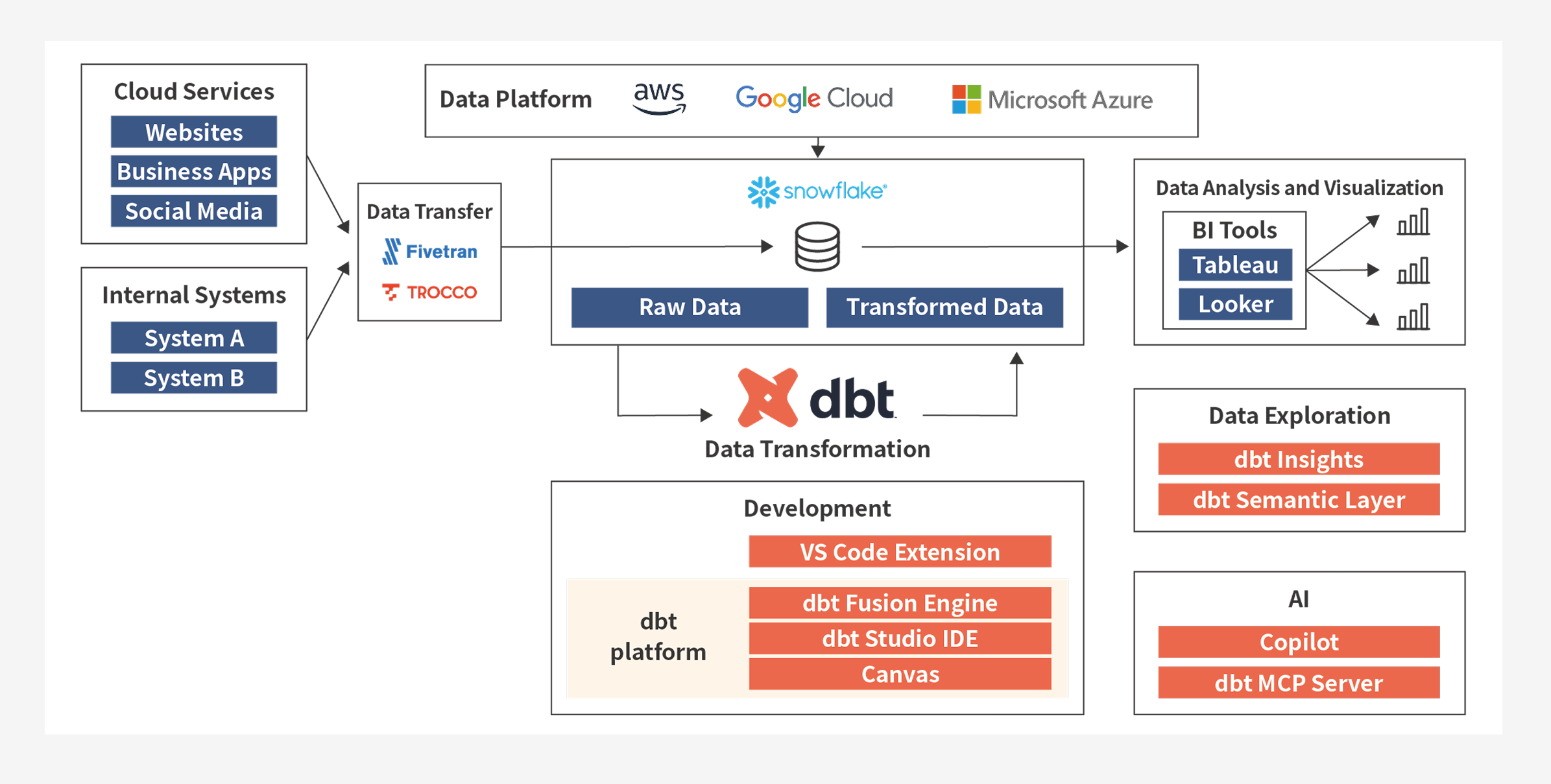
A dbt-Centered Architecture That Links Data Transformation, Analysis and Utilization
We can build a modern data stack that balances scalability with operational manageability.
DATUM STUDIO Capabilities
With a team of over 200 data engineers and AI engineers, DATUM STUDIO entered into a service partner agreement with dbt Labs in June 2023.
In 2025, the company was recognized as a “Visionary,” the highest tier in the dbt Labs partner program, and in 2026, DATUM STUDIO received the APJ Partner of the Year award at the dbt Labs Partner of the Year Awards.
DATUM STUDIO leverages its deep understanding of dbt’s philosophy and architecture to provide end-to-end support from data modeling design to the establishment of operational frameworks. By building efficient, scalable data analytics platforms, we help our clients achieve data-driven management.


Frequently Asked Questions
- QHow is dbt different from other ELT tools?
- Adbt is a tool for handling the transform step of ELT workflow.
A common configuration is to use tools such as Fivetran or TROCCO to extract and store data, then to use dbt to prepare it for analytics.
We support clients in designing and operating an optimal architecture that integrates these technologies.
- QWhat is the difference between dbt Core and the dbt platform?
- AThe main differences are as follows:
dbt Core dbt platform Delivery model OSS SaaS Execution environment Built and managed within your own infrastructure Provided as a managed cloud service Job management Built by integrating external orchestration tools Standard built-in CI/CD (Only required models are executed, helping optimize both time and cost) UI Primarily CLI (command-line interface) Development available both in the browser and local IDE. Data lineage, model and job execution details provided through a web UI Access control Managed through Git or the data warehouse Standard built-in features such as RBAC, SSO and MFA AI development The dbt MCP server only executes dbt commands Metadata accumulated in the dbt platform can be retrieved via the dbt MCP server dbt Core is suited to small-scale projects where budget is a major concern. dbt platform is more appropriate for projects where team development and governance are particularly important.
The optimal choice depends on your operational structure and future scalability requirements. We will propose the most appropriate configuration to meet your specific needs.
- QCan dbt be implemented with our existing data warehouse?
- AYes.
dbt supports major cloud data warehouses such as BigQuery and Snowflake, making it possible to implement dbt while continuing to use your existing environment.
We will propose the optimal configuration, including how dbt should integrate with your current data pipeline.
- QHow long does it take to implement dbt, and how much does it cost?
- AImplementation timelines and costs vary depending on the scale and objectives of the introduction.
A small-scale initiative such as proof of concept can begin within a few weeks.
Production deployment can also be expanded in stages by incrementally establishing models and operational frameworks, helping control development workload and costs.
We can propose an optimal implementation plan tailored to your company’s specific requirements.
- QCan you provide support until our team can operate dbt internally?
- A
Yes. Our support goes beyond the initial implementation to include operation and insourcing.
For example, we help establish sustainable practices through initiatives such as:- Standardizing data model design
- Implementing data tests and documentation
- Designing operational processes including development workflows (Git, etc.)
- Training in-house team members
We support a practical, step-by-step approach to adoption in line with your team’s in-house structure and maturity level.
Note: The content on this page is based on information available as of March 2026. Please feel free to contact us for the latest updates.