Partner | Databricks
Seamless integration of data and AI on a unified platform


What Is Databricks?
Databricks is a cloud-based data platform that enables end-to-end execution of data collection, processing, analytics and AI workloads.
By integrating traditionally siloed data analytics and AI workloads into a single platform, Databricks accelerates data utilization in business.
Why Choose Databricks?
Databricks is a single unified platform for the execution of data processing, analytics and AI workloads, which are often handled separately. It delivers high-speed processing of large-scale data while providing the flexibility to scale in line with business growth. In addition, Databricks supports integrated LLMOps and MLOps, streamlining the entire lifecycle of AI and machine learning models from development and validation to production, to seamlessly link data and AI for continuous value creation.
Issues Databricks Can Resolve
Establishing a Secure Data
Management Foundation
Databricks centralizes the management of data assets, including metadata, on lakehouse architecture to provide visibility into data lineage. With its robust access control and governance, Databricks establishes a data management foundation that supports data utilization across organizations.
Building an AI-Ready
Data Platform
Lakehouse architecture combines the best elements of data lakes and data warehouses. It enables unified management of diverse data sources, including both structured and unstructured data. Analytics, machine learning and generative AI workloads run on the same platform, creating an analytics and AI foundation that scales flexibly across different use cases.
Stable Operational Framework
with LLMOps and MLOps
Databricks enables integrated execution of LLMOps and MLOps, providing end-to-end support for AI and machine learning models from development and deployment to monitoring. Using MLflow* improves reproducibility in model development and simplifies model management, enabling stable operations while optimizing costs.
Safe Operation of
Generative AI for Business Use
Databricks provides end-to-end management for generative AI models designed for real-world business applications, from training and production deployment to operation and monitoring.
Designed to incorporate governance and security, it helps companies improve business productivity through the safe operation of generative AI in a production environment.
MLflow is an open-source platform for managing the lifecycle of machine learning models and AI agents from development to operation.
It is natively integrated into Databricks as a standard feature for seamless use within the platform.
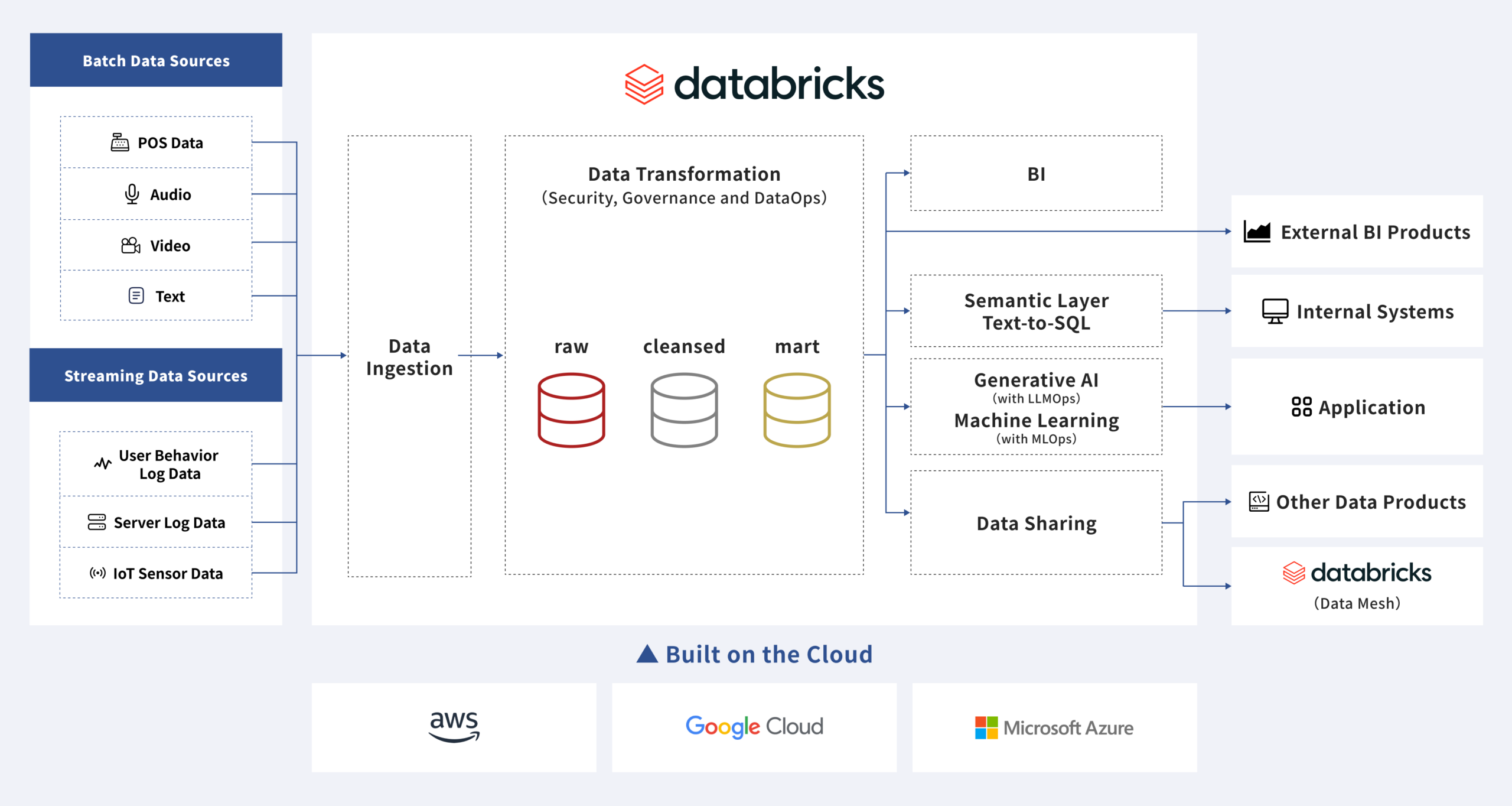
Data and AI Utilization Workflow with Databricks
Using Databricks makes it possible to execute the entire workflow—from data collection, processing and analytics to machine learning and generative AI in production—within a single unified platform.
This integrated approach eliminates the silos that historically separate data and AI to establish a workflow that delivers ongoing value in business.
DATUM STUDIO Implementation Support for Databricks
As a Databricks partner, DATUM STUDIO supports client companies in introducing data intelligence platforms that enable effective utilization of data and AI.
Our team includes more than 200 data engineers and AI engineers. Members with in-depth expertise and practical knowledge of Databricks leverage an extensive track record to support the implementation of advanced data and AI use cases.
Moreover, we go beyond building analytics platforms using Databricks to provide end-to-end support that extends to the execution of initiatives integrated with business systems such as CRM, helping to drive data-driven operational efficiency and create new business value.

Frequently Asked Questions
- QWhat are the key features of Databricks?
- ADatabricks adopts lakehouse architecture that integrates data and AI workloads within a single platform.
By enabling end-to-end execution from data collection, processing and analytics to machine learning and generative AI in production, data can be utilized across departments for faster decision-making and improved business outcomes.
- QWhat types of issues can Databricks resolve?
- ADatabricks is particularly effective in resolving the following issues.
- Rapid growth in data volume that limits processing performance and drives up costs in existing data warehouses
- Siloing of analytics and machine learning platforms that raises system complexity, increasing time and costs required for additional development and operation
- AI utilization that remains at the proof-of-concept stage and fails to reach production
With its integrated operating platform, Databricks provides a simpler, more efficient environment for managing data and operating AI models.
- QWhat is the difference between a lakehouse and a data warehouse?
- A
A lakehouse is an architecture that combines the flexibility of a data lake with the manageability of a data warehouse.
While data warehouses are primarily designed for structured data analytics, lakehouse architecture can handle a wide variety of data formats other than just tabular data, including logs, images and text, within a single platform.
This supports execution of the full workflow from analytics to AI, machine learning and generative AI in production.
- QCan Databricks integrate with existing data warehouses?
- A
Yes.
Databricks can integrate with major cloud data warehouses such as Snowflake and BigQuery.
Organizations can continue to utilize their existing data warehouses while extending their architecture with a data lake layer on Databricks.
This enables the integration of analytics, AI and machine learning within a single platform, supporting continuous data utilization.
- QHow long does it take to introduce Databricks, and how much does it cost?
- A
Introduction timelines and costs vary depending on the scale of the deployment and the state of the existing data infrastructure.
A small-scale initiative such as proof of concept can begin within a few weeks.
Production deployment can also be expanded in stages by incrementally establishing models and operational frameworks, helping control development workload and costs.
We can propose an optimal introduction plan tailored to your company’s specific requirements.
- QHow does Databricks ensure governance and security during AI use cases?
- A
Unity Catalog, a governance solution for integrated management of data and AI assets on Databricks, enables centralized visualization and management of access permissions for data and AI models, audit logs and data lineage.
This ensures governance and security while enabling the safe use of AI and generative AI.
Note: The content on this page is based on information available as of March 2026. Please feel free to contact us for the latest updates.